Goddesses in the Garden

I’m so excited about this next growing season! This is the 5th summer since the shovel first entered the ground back in the Spring of 2015 and as you can see from the picture, the echinacea lined entrance leads the way to the tea tent, but like any good traveler knows, the magic is not just about arriving at your destination, but the journey to get there. With the Tulsi Rose Garden first you travel up a rainbow flowered pathway. Hibiscus, galliardia and fiery nasturtiums welcome you to use the metaphor of the heat of the fire to cleanse and purify that which you do not need anymore. Like the goddess Innana who removed all of her jewelry and clothing to become vulnerable to the essence of her soul, we see the benefits of releasing our old patterns and preconceived notions to become more present and available to the energies of the current moment. Further up as you pass through all of the purple flowers you’re invited to open to your own vision and intuition. The garden is constantly teaching me through movement and poetry. She is very much like the sacred center of a woman. She likes to be approached with gentle reverence to enter her inner chambers. . . like with any good foreplay there is curiosity, openness and respect. She teaches me to bow and honor as I enter through her gateway. She shows me that the spiral is an opportunity to drop more deeply into my body and is the perfect invitation to practice earthing, grounding and walking meditation where I can really connect to the subtle energies of the earth. She celebrates when I raise my arms up in the sun breath as I walk, and as I breathe more deeply she shows me more about how my own intuition deepens and opens to the mysteries of connection to my own higher self and vision. . . often words or songs pour through me as I’m exploring the movements and connection to the garden. There is a stillness, a quietness at times with the plants, then at other times there are the songs of birds, buzzing of bees or the sounds of planes flying high overhead. This is a portal to the magical connection we have with the world around us. . . a place to enhance our senses of sight, sound and smell, feeling the air and the temperature of the nature of the day with our bodies.

This is the temple, we are the temple. . . our bodies are our temples. It is here that I invite you to drop into your own nature and become more attuned to the plants and your own intuition. It is here where we can develop our goddess nature, one of true harmony with each other and the planet. . . where we hone our skills of presence, connecting with our hearts and explore our energetic container.

The Goddesses in the Garden program is a 6 month program for women which is a training in connecting with your own intuition and connecting with the plants, specifically, tulsi, rose and lavender, but you may find that a different plant ally calls to you. We meet one day a week from 10-3. In this program we will sometimes be in the garden and sometimes we’ll be at the Sacred Sanctuary healing center where we will learn deeper practices of meditation, breath connection and cosmic alignment with the light energy that runs through our bodies.

Our foundation is to come together in circle with each other to support with spiritual practice. . . learning and deepening our skills of telepathic communication with the plants. . . as we take the time to center and deepen our own breath we become more present to listen and hold council for one another. We will share in the safety of our circle to create a container for learning healing techniques and at other times we will take our practice to the garden where we will spend time with the plants, caring for them and listening to the messages on the wind that they have for us. Having this sacred time in the garden to feel the sun, the air and to listen on the winds allows us to come more and more into alignment with our true nature and manifest the qualities we admire in others to bring more love and abundance to ourselves and the world.

If this feels like a journey you would like to explore, I invite you schedule a connection call where we can discuss how this program might help you in your life. Payment plans available. 413-212-1665

Bright Blessings, Sulis
Tapping on Brighid’s Ground

goddess-of-spring

Tap, tap, tap. . . wake up hibernating bear, wake up  dormant seeds. . . it’s almost time to come out and play.  

This past weekend was Imbolc, the cross-quarter day between Winter Solstice and Spring Equinox, the beginning of Spring!   Here in New England unlikely warm temperatures in the 50’s has been melting the snow, but we can be pretty sure that we’ll have more snow. . . just how much we don’t know!

In Celtic Ireland, Imbolc was also known as Brighid’s Day. She is known as the protector of the wells in Ireland.  Daughter of Dagda, the earth god, and Boann, the goddess of fertility. They belonged to an ancient tribe of gods, called Tuatha Dé Danann (people of the Goddess Danu).

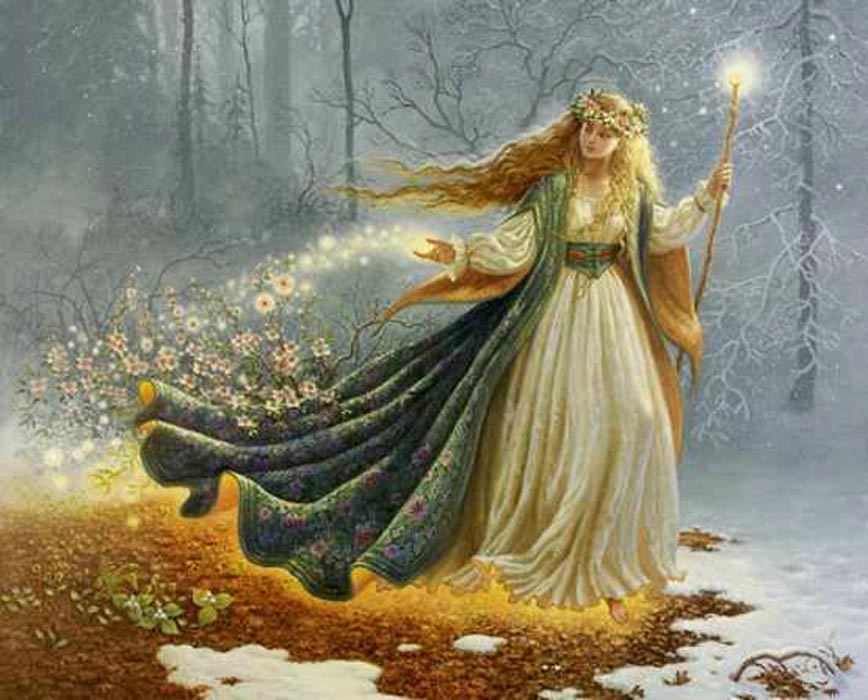
The people of Ireland hold Brighid in high esteem.  It’s said that she was born at sunrise and  a column of fire rose up out of her head.  There are many stories about how Brigid became known as the triple goddess of smithcraft, herbalism and poetry.  One story says that she broke the flame of inspiration off at her crown and threw it down in front of her to become the hearth of the home.  Then she swallowed the fire and it wiggled and jiggled and danced inside her and came out through her hands as healing energy and the ability to forge metal into objects.  She is known for healing with herbal teas, using the blessed waters of the well and sparking the inspiration of the mind to create a flow of beautiful words.

Brighid was so beloved in all of Ireland that people are still honoring her at holy wells, like the one at Kildare where people tie clooties to the trees next to the healing wells. Clooties are strips of cloth that are sometimes used as a rag or to patch clothing, but here they are tied to symbolize a prayer.

Brighid is particularly associated with the first stirrings of Spring as the days begin to lengthen.  Soon the snow drops will emerge as our first flowers, then the crocus and soon enough the daffodils.  I have a Spring Emergent flower essence blend to assist in our own awakening to the energy of Spring and to assist us as we get into gear to work with our gardens again and enjoy the blessings of the Spring days.  With this turning of the cycle we are also expecting the renewed cycle of life with the new babies. Dairy cows and ewes are also associated with Brighid.  Here at the Tulsi garden my friends often keep goats and Spring is the time for their babies to emerge.  My first year at the farm I got to witness the birth of beautiful twin goats on April 9. . . lots of emerging energy here with the coming of Spring.

Most of the stories that we have about Brighid are myths and legends passed down through the centuries, “The Book of Invasions tells us that Brigid was the wife of Breas and had a son named Ruadan. Legend has it that the Fomoire sent Ruadan to kill Goibniu, the smith. Ruadan was able to wound Goibnui with a spear, but was himself slain in revenge. Brigid came to bewail her son, which was the first time crying and shrieking was heard in Ireland, the first keening.” (from Brigid: Flame of Two Eternities; add.org)

Although the Brighid who was known to the ancient Celts through legend was prominent in the consciousness of the people’s of those early times, in the 5th century a woman came to prominence who became known as St. Brigid. Here is an account of her from ancient-orgins.net:

St Brigid of Ireland appears

When Ireland was Christianized, the monks and priests needed good examples to inspire people to follow the new faith.  They used the same method as in the other parts of the world and started to create stories which sounded familiar to the inhabitants of the converted areas. In one of these stories they described a woman who connected two cultures.

According to Catholic resources, St Brigid was born 451 or 452 AD in Faughart, near Dundalk, County Louth. She was said to be a daughter of a Druid man and a slave woman. Brigid reportedly refused many marriage offers and decided to become a nun. She settled for some time near the foot of Croghan Hill with seven other virgin nuns. They are said to have changed their home a few time, but finally the nuns lived in Kildare, where Brigid died as an old woman on February 1, 525 AD. The Catholic Church argues that the date of her death is a coincidence; however it also provides a meaningful link between the Celtic goddess and Christian Saint.

Saint Brigit as depicted in Saint Non’s chapel, St Davids, Wales. ( CC BY-SA 3.0 )

In legends St Brigid was a daughter of Dubtach. She was perhaps prepared to be a Druid, though in the end she became a nun. This was quite a popular solution for wise people of pre-Christian religions: To avoid problems, many of them preferred to become a part of monasteries and continue their practice connected with the ancient ways as “Christians.”

Like the goddess, St Brigid is associated with fire too. The first biography written about her was made in 650 AD by St Broccan Cloen. However, in the 20th century many researchers began to doubt the historical evidence for her life. The saint wrote:

”Saint Brigid was not given to sleep,
Nor was she intermittent about God’s love;
Not merely that she did not buy, she did not seek for
The wealth of this world below, the holy one.”

The stories of St Brigid have some unusual details that differ from typical early medieval legends of Christian saints. One of the strangest examples is a story of her life with a woman named Dar Lugdach. According to the descriptions these two women used to sleep together, but not for a lack of the space or beds. The name of the potential lover of St Brigid means “daughter of the god Lugh.” Moreover, St Brigid’s miracles are often strongly related to Druid knowledge about alchemy, magic, and other disciplines.

untitled

From Salem’s moon:

About the year 470 St. Brighid founded the double monastery at Cill Dara (Cell of the Oak) now called Kildare.
Cill Dara is famous for the sacred perpetual fire that was tended by nineteen nuns. Today people around the world take it in turns to keep the sacred flame burning continuously.

Saint Brigid’s feast day is on the 1st February celebrated as St Brigid’s Day in the Roman Catholic Church, the Eastern Orthodox Church and by some Anglicans. The Gaelic festival coincides with Imbolc, which is a pagan festival associated with the goddess Brigid.